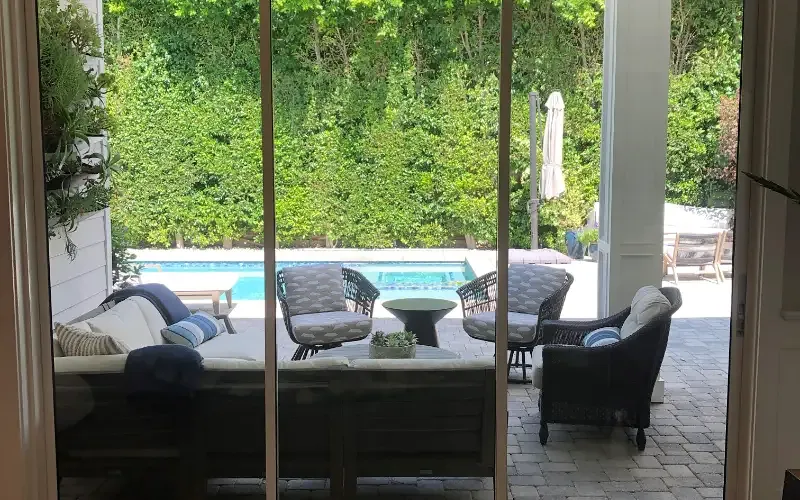
Every home we look at in Beverly Hills has one room nobody uses in the afternoon. It's almost always on the west side, it's almost always the room with the best view, and the reason is sitting right there in the glass. Here's what's actually happening, and what film does about it.
Sunlight is three different things
What comes through your window isn't one thing, it's three. Visible light is the part you see and want. Infrared is the part you feel as heat. Ultraviolet is the part that fades your floors and furniture. Ordinary clear glass lets nearly all three straight through, which is why a room can be beautifully bright and completely unusable at the same time.
The whole trick of modern window film is separating those three. A good spectrally selective or ceramic film lets most of the visible light in while rejecting the large majority of the infrared and essentially all of the UV. That's why residential window tinting today doesn't have to mean dark glass — the darkness was never what was doing the work.
Why the west side is the worst side
Two things gang up on west-facing glass. First, the afternoon sun sits low, so it comes in at a shallow angle and travels deep into the room instead of landing on the sill. Second, it arrives at the hottest part of the day, on top of a house that has already been absorbing heat since morning.
The result is the pattern we see constantly in Los Angeles: the west rooms run five to fifteen degrees warmer than the rest of the house, the AC runs continuously trying to even it out, and the drapes stay shut on the best windows in the building.
What film actually delivers
Here's what to expect from a properly specified film on a problem exposure:
- Up to about 80% of infrared heat rejected, which is what you feel as a difference in room temperature.
- 99% of UV blocked, so hardwood, rugs, art, and upholstery stop fading.
- Glare cut to the point where screens are readable with the drapes open.
- Cooling systems that cycle instead of running continuously through the afternoon.
What it won't do is turn a greenhouse into a cellar. Film reduces solar gain through the glass, but it doesn't touch heat coming through an uninsulated roof or a west wall, and it can't fix a badly undersized AC system. Any installer promising a fixed number of degrees without looking at your house is guessing.
Choosing between the film families
Ceramic films are the workhorse for homes: strong heat rejection, no metal, no signal interference, and a natural look through the glass. Spectrally selective films go further on keeping the glass looking clear, and cost more for it. Dual-reflective films reject the most heat and add daytime privacy, at the price of a visible exterior look that not every HOA or historic property will accept.
There's also a safety question worth folding into the same decision. If you're already treating ground-floor glass, security film gives you the UV and containment benefits alongside forced-entry resistance, and it's usually cheaper to do both in one visit than to come back later.
The dual-pane warning
If your windows are dual-pane, or already have a factory tint or low-E coating, film selection stops being a preference and becomes a calculation. The wrong product can raise the glass temperature enough to cause a thermal stress crack, and it can void the glazing warranty at the same time.
This is the single most common way a cheap film job turns expensive. We run thermal stress numbers on the actual glass before quoting, every time. If you're getting bids, ask each installer what they've assumed about your glass makeup. The answer tells you a lot. Get a free assessment and we'll tell you exactly what you're working with.